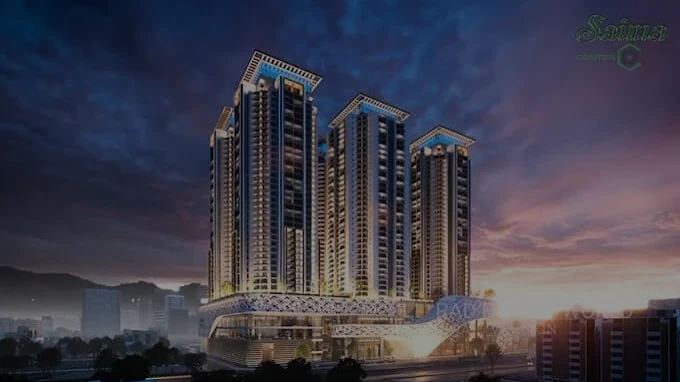
There’s a particular kind of commercial address in Karachi that people mention almost automatically when the conversation turns to serious business not because of any marketing push, but because the name has been floating around investor circles long enough to stick. Saima Corporate Center Karachi has become one of those names. Ask around among people who deal in commercial property here, and this project comes up fairly often, usually in the same breath as questions about location, pricing, and whether it’s actually worth the money.
I think the honest answer is that it depends on what you’re looking for, but there’s enough substance behind this project to make it worth a proper look. A known developer, a location that isn’t buried somewhere inconvenient, and a mix of office space, retail shops, and business suites that gives buyers more than one way to use or profit from the same building. That combination is rarer in Karachi’s commercial market than people sometimes assume.
This piece goes through the whole picture. What the project actually is. Who’s building it. Whether the paperwork checks out. What it costs, roughly, and how you’d pay for it. What’s actually inside the building once it’s finished. And whether, at the end of all that, it makes sense as something you’d put your money into.
At its core, Saima Corporate Center is a mixed-use commercial tower with corporate offices, retail shops, showrooms, and business suites, all housed under one roof rather than scattered across separate buildings the way a lot of older Karachi commercial areas tend to be organized. The idea seems to be fairly straightforward: give business owners a modern workspace that also functions as a legitimate investment property, and give investors a building with enough variety in unit types that demand doesn’t rely on just one kind of tenant.
Walk through the design intent and you notice it leans more toward a contemporary business hub than a traditional commercial plaza. There’s a clear separation between the retail floors, which are meant to handle daily footfall and walk-in customers, and the office floors above, which are quieter, meant for people who actually work there rather than shop there. It’s a fairly common approach in newer commercial towers, but it’s not something every developer in this city bothers getting right.
Saima Group is the name behind this project, and if you’ve spent any time around Karachi real estate, that name probably isn’t new to you. The developer has built both residential communities and commercial towers across the city over the years, and this matters more than people sometimes give it credit for it has actually delivered most of them.
That track record is really the thing worth paying attention to here. Plenty of developers in Karachi have made big promises on glossy brochures and then quietly gone silent for years while a project sits half-finished. Saima Group doesn’t really have that reputation. Whether that’s enough on its own to justify a purchase is a separate question, but it does remove one of the bigger risks buyers usually have to worry about with newer or lesser-known names.
Approval status is one of those things that sounds like a formality until it isn’t. Karachi has seen enough projects run into regulatory trouble stalled construction, disputed land titles, and missing approvals that checking NOC status has become a genuinely essential step rather than a box-ticking exercise.
Saima Corporate Center has obtained its No Objection Certificate from the relevant municipal authorities, which is a reassuring sign for anyone considering a purchase. That said, and this is worth saying plainly: buyers should still independently verify the current approval status directly with the developer or the authority in question before committing any money. Regulations shift, documentation gets updated, and a status that was accurate six months ago isn’t necessarily accurate today. It’s a small extra step that protects a fairly large amount of money.
This is honestly where a lot of the project’s appeal comes from. The location sits close to some of Karachi’s busiest commercial corridors, which means tenants and business owners get reasonably quick access to the city’s core economic activity without getting stuck in the kind of narrow, congested side streets that plague many older commercial areas.
For a retail tenant, that kind of positioning translates almost directly into footfall. For an office tenant, it translates into convenient clients and staff who can actually get there without a headache. Both things matter, and it’s rare for one location to genuinely serve both needs well.
Commercial units sitting inside a recognized, well-located tower tend to pull in higher rental income than standalone shops scattered across less organized commercial strips. Part of that comes down to something almost psychological: tenants, whether they’re retailers, corporate offices or service businesses, generally prefer having a known, credible business address attached to their name. A generic shop on an obscure street doesn’t carry the same weight as a unit inside a recognized tower, even if the square footage is identical.
Karachi’s commercial property market has generally trended upward over a longer horizon, even accounting for the usual ups and downs any real estate market goes through. Projects backed by an established developer in a genuinely strong location tend to appreciate faster than generic commercial stock scattered around the city with no particular locational advantage. That’s not a guarantee, of course; nothing in real estate really is, but it does tilt the odds in a buyer’s favor.
There’s a reason people keep circling back to this point. Buying into a Saima Group project means buying into a company with decades of delivery history rather than a name nobody’s heard of before. In a market where trust genuinely is the deciding factor for a lot of buyers, sometimes more than price or even location, that reputation carries real weight.
Yeh content SEO aur readability ke hisaab se zyada natural aur professional version hai.
The Saima Corporate Center Karachi enjoys a prime location at PIDC, opposite Pearl Continental (PC) Hotel, placing it in the heart of Karachi’s commercial district. Its central position provides excellent connectivity to the city’s major business hubs, financial institutions, and upscale residential communities, making it an ideal destination for corporate offices, retail businesses, and investors.
The project offers direct access to Beaumont Road and is only minutes away from Shahrah-e-Faisal, allowing convenient travel across Karachi. With Clifton, DHA, Saddar, and I.I. Chundrigar Road nearby, businesses benefit from strong commercial activity, high visibility, and a steady flow of visitors throughout the day.
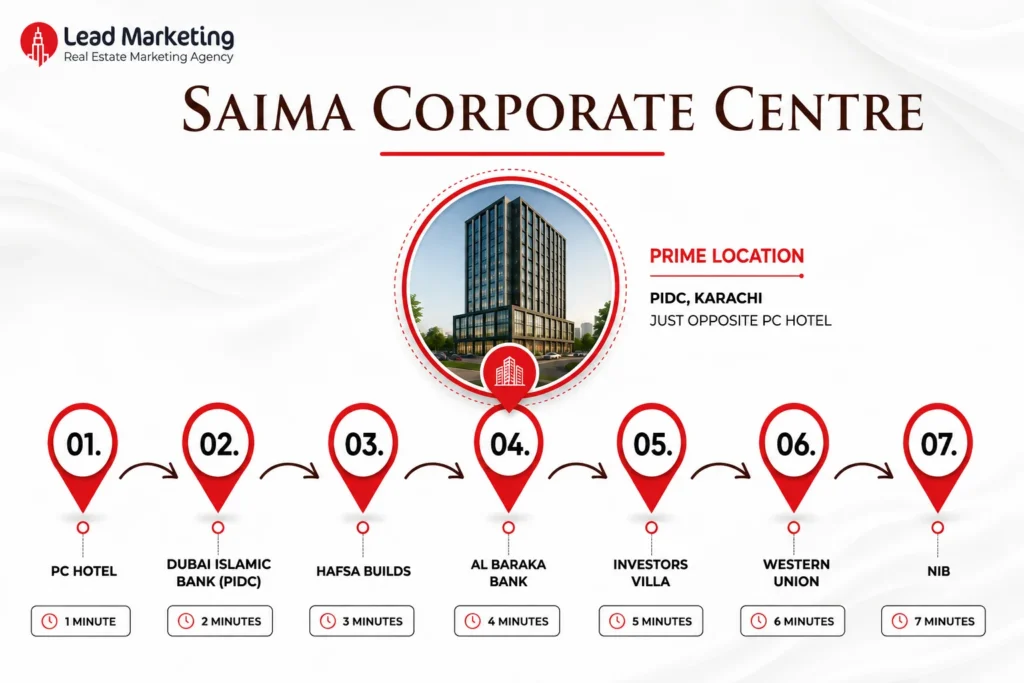
The Saima Corporate Center Karachi location map highlights the project’s exceptional accessibility from every major part of the city. Located opposite PC Hotel at PIDC, the development connects seamlessly to Karachi’s key commercial corridors, ensuring quick and hassle-free commuting for businesses, employees, and clients.
Its strategic location offers fast access to Shahrah-e-Faisal, Clifton, DHA, PECHS, Tariq Road, Saddar, and I.I. Chundrigar Road. Jinnah International Airport is also within a comfortable driving distance, making the project especially suitable for companies that frequently host local and international clients.
Yeh version zyada professional, natural aur real estate website ke liye optimized hai. Isme unnecessary repetition remove kar di gayi hai aur readability bhi kaafi improve ho gayi hai.
Saima Corporate Center offers premium office spaces for businesses that value a professional corporate address and a modern working environment. These offices are ideal for consultancies, corporate headquarters, branch offices, IT firms, financial institutions, and other service-based businesses looking to establish a strong presence in Karachi’s prime commercial district.
Ground and lower floors are generally set aside for retail, and there’s a reason for that beyond just tradition. Shop owners on these floors get visibility and passing footfall that upper-floor units simply can’t compete with, no matter how nicely they’re finished.
Larger-format units meant for businesses that genuinely need display space — furniture retailers, electronics brands, lifestyle stores, anything that benefits from a strong visual presence rather than a small storefront tucked in a corner.
Smaller, more flexible spaces aimed at startups, freelancers, and small teams who want a legitimate business address without committing to an entire floor they don’t actually need yet.
The Saima Corporate Center Karachi floor plan has been carefully designed to meet the needs of modern businesses. The tower follows a well-planned vertical layout that separates retail, parking, and corporate office spaces to ensure smooth operations and a professional working environment. Every floor maximizes usable space while maintaining efficient circulation, accessibility, and convenience for businesses of all sizes.
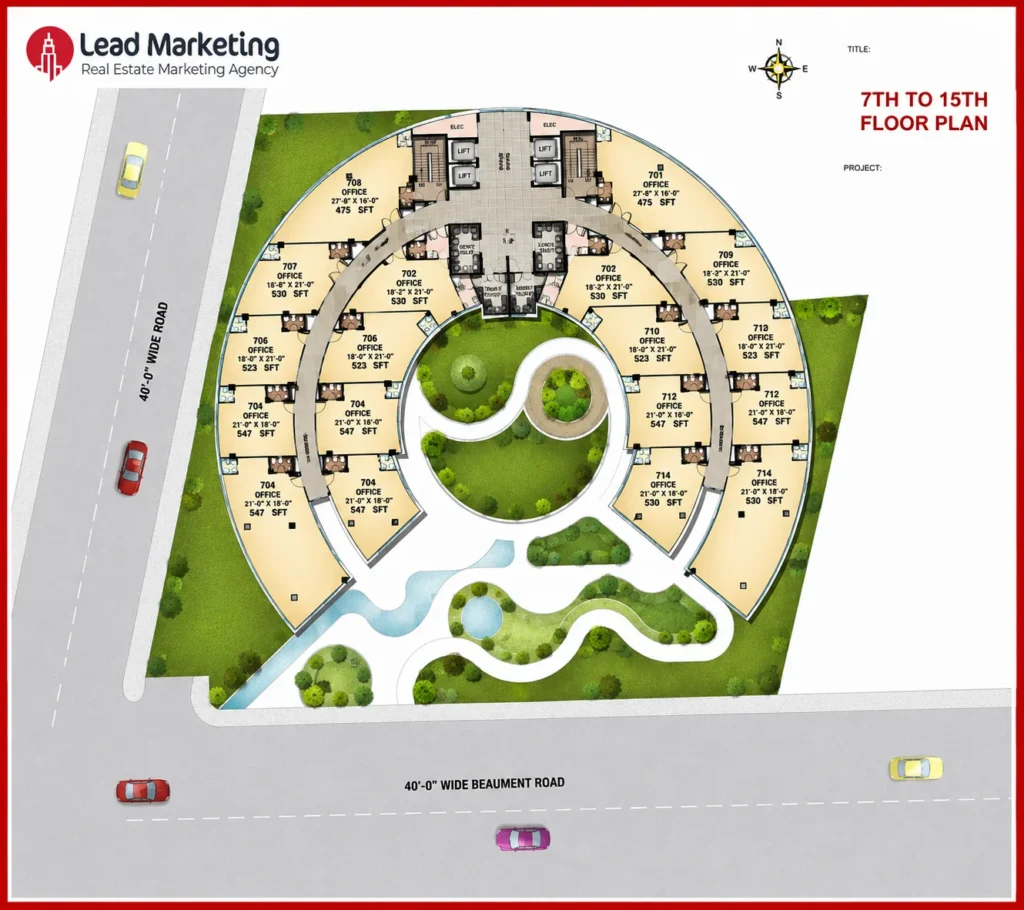
The project includes dedicated parking levels, premium office floors, and recreational facilities, creating a complete commercial ecosystem. Spacious office layouts, modern lift access, wide corridors, and well-planned common areas enhance the overall workplace experience. Whether you are purchasing office space for your own business or as an investment, the floor plan is designed to support long-term functionality and value.
The master plan reflects an attempt to balance pure functionality with something closer to an actual business district feel dedicated parking that doesn’t feel like an afterthought, common areas built with business use in mind rather than just decorative lobbies, and enough vertical space to comfortably fit a genuine mix of unit types without the building feeling cramped or overstuffed. It reads less like a repurposed shopping plaza and more like an actual corporate office tower built with that specific purpose from the start.
The Saima Corporate Center Karachi payment plan is designed to make commercial property ownership more accessible for investors and businesses. Buyers can secure an office with a low booking amount and complete the remaining payments through flexible monthly, quarterly, and construction-linked installments.
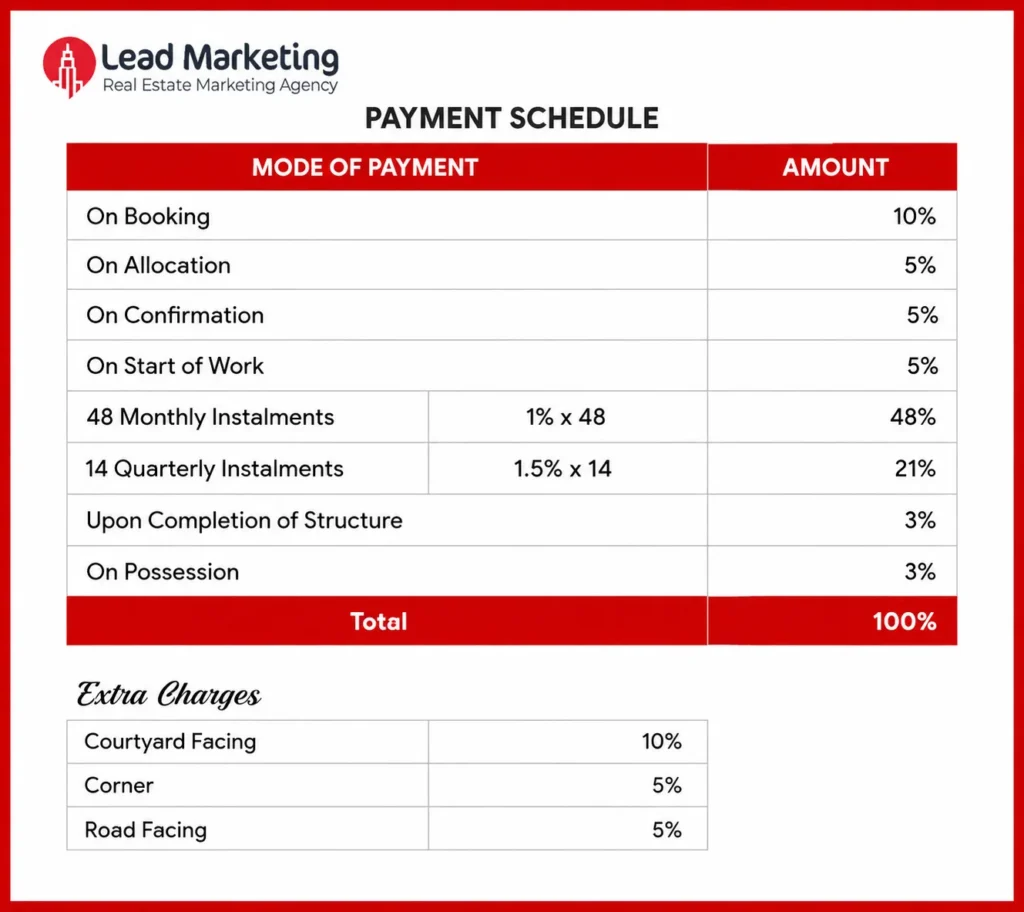
The payment process begins with a 10% booking amount, allowing buyers to reserve their preferred office while locking in the current price. Early booking also protects investors from potential price revisions during future project phases.
After the booking amount is received, the unit is formally allocated to the buyer. Allocation is followed by the confirmation payment, which finalizes the reservation and secures the selected office within the project.
The remaining amount is distributed through 48 monthly installments and 14 quarterly installments, making the investment affordable and easier to manage. This flexible structure allows businesses and investors to plan their finances without the burden of a large upfront payment.
The payment schedule also includes milestone-based installments during the construction phase. This approach aligns payments with the project’s progress while providing greater confidence and transparency for buyers.
The final payment is made before possession, after which buyers can take ownership of their office space. Any applicable additional charges, such as courtyard-facing, corner, or road-facing premiums, are payable according to the official payment schedule.
The flexible payment plan allows buyers to own a premium commercial unit without paying the full purchase price upfront, making investment more affordable and financially manageable. Spreading the cost across booking, confirmation, and staged installments is one of the more buyer-friendly aspects of the project, particularly for investors who’d rather keep some capital free for other opportunities instead of tying it all up in one transaction.
Pricing shifts depending on unit type, floor, and size, and that’s fairly typical for a mixed-use commercial tower. Retail shops on lower floors usually carry a premium over office units higher up, simply because ground-floor visibility is worth more to a retailer than an identical square footage tucked away on the sixth floor. Business suites, meanwhile, tend to sit at a more accessible price point, which makes them a reasonable entry point for smaller investors or first-time commercial buyers.
For exact, current figures, it’s genuinely best to reach out directly for the latest price list. Commercial pricing in Karachi tends to move with market conditions more than people expect, and numbers that were accurate a few months ago can be noticeably out of date by the time you’re actually ready to buy.
A proper reception lobby sets the tone the moment someone walks in, and that first impression matters more for a commercial building than people sometimes assume. Clients notice these things, even if they can’t quite articulate why.
Fast, reliable elevator access matters more in a commercial tower than in almost any residential building, simply because of the sheer volume of daily foot traffic moving between floors during business hours.
Dedicated parking is a genuine, practical advantage in Karachi’s commercial districts, where parking shortages are a near-constant headache for both business owners and the clients trying to visit them.
Round-the-clock security protects both tenants and their goods, and that matters especially for retail and showroom units, which tend to carry more physical inventory than a typical office space.
Comprehensive CCTV coverage across common areas and entry points adds an extra layer of protection that most tenants notice and appreciate, even if it’s rarely something they think about day-to-day.
Given Karachi’s ongoing power situation, backup power isn’t really optional for a serious commercial building anymore it’s closer to a baseline requirement that keeps operations running regardless of outages in the surrounding grid.
Every commercial development should include a properly installed firefighting system because it provides essential safety, not an optional feature.
A dedicated prayer area gives tenants and visitors a convenient, private space for daily prayers without needing to step outside the building.
A shared business lounge offers a more relaxed setting for informal conversations, quick meetings, or simply a break away from a desk without leaving the premises entirely.
Bookable meeting rooms are genuinely useful for smaller businesses that don’t have the space or the need for a dedicated conference room of their own.
Central air conditioning keeps the entire building comfortable year-round, which matters considerably more in Karachi’s climate than it might in a cooler city.
Ongoing maintenance services help keep common areas and building infrastructure in reasonable shape well after handover, which is often the difference between a building that ages gracefully and one that starts looking tired within a couple of years.
Commercial real estate in Karachi has generally delivered steadier, more reliable rental income than residential property over time, and a project like this one, backed by a known developer and sitting in a genuinely strong location, adds an extra layer of confidence for anyone chasing high ROI in a market that can otherwise feel unpredictable. Layer a flexible payment plan on top of that, and it becomes a genuinely accessible investment opportunity even for buyers who might otherwise feel priced out of Karachi’s commercial real estate market entirely.
Diversification also offers clear advantages. A single commercial unit inside a mixed-use tower like this one spreads risk across different tenant types retail, office, showroom rather than betting everything on one kind of demand holding steady indefinitely.
Buying commercial property in Karachi comes loaded with paperwork, verification steps, and negotiation that can get genuinely overwhelming for anyone doing it without proper guidance especially first-time commercial buyers who aren’t sure what questions to even ask. Working with an experienced real estate consultancy means getting accurate, current information on pricing, payment structures, and unit availability, rather than relying on scattered listings, outdated brochures, or word-of-mouth that may or may not still be true. Buyers often need the most guidance when they verify documents, negotiate the final price, or choose the right unit for their goals instead of simply accepting the option that sales teams promote most aggressively.
House of Well 2 by WELL Concept Real Estate Development sits on the Dubai Islands. House of Well…
The Woods Abode Dubai by Sobha. He started depicting Sobha Sanctuary. This project consists of two types of…
Dolce Residences Ras Al Khaimah by Wyndham is a project by BNW Developments. It sits on Al Marjan…
Sorrento at DAMAC Lagoons is a newly launched residential apartment project by DAMAC Properties in Dubai. It sits…
Regatta Residences by Futura Edge Development and One Yard Real Estate Development unveils a purposeful, secluded waterfront address…